

Parkers Prairie
On the Crossroad to the Prairie & A Gateway to Lakes Country

Talking Trail Audio Story
(no audio file for this site)
Founding Parkers Prairie
The establishment of Parkers Prairie is the direct result of the great post Civil War (1861-1865) push west. In the fall of 1867, two government surveyors Warren Adley and a man known only as Parker, left Osakis, Minnesota to blaze a trail to Otter Tail City. After struggling through dense timber, swamps and marshes, they came upon the southeast corner of a long narrow prairie. At the point where they encountered the prairie was a lake. Seeing the potential of the rich prairie for settlement, they named both the lake and prairie after themselves – Lake Adley and Parkers Prairie.
Considered one of Otter Tail County’s earliest settlements, Parkers Prairie can trace its establishment back to 1868. While the first two settlements, Clitherall in 1865 and Rush Lake in 1867 had religious foundations, Parkers Prairie was not settled by people with any distinct religious affiliation.
![Parkers Prairie Historical Monument Dedication, June 29, 1930 [dedicated
by Otter Tail County Historical Society]
Standing (l to r): Johannes Peterson, Willis A. Smith, Hugh Hall, Frank A.
Saunders, Peter Lindall, J.W. Hazen, Andrew Hanson
Seated (l to r): Mrs. John Algot (Swenson) Peterson, Lillian Saunders Terry,
Seated on right (l to r): Mrs. George Grotey, Minnie Nelson Bergquist](https://eadn-wc02-557916.nxedge.io/cdn/wp-content/uploads/10449dpi600-1024x804.jpg)
Standing (l to r): Johannes Peterson, Willis A. Smith, Hugh Hall, Frank A. Saunders, Peter Lindall, J.W. Hazen, Andrew Hanson
Seated (l to r): Mrs. John Algot (Swenson) Peterson, Lillian Saunders Terry,
Seated on right (l to r): Mrs. George Grotey, Minnie Nelson Bergquist
End of the Trail Monument
The End of the Trail monument marks the end of the first trail into Southeastern Otter Tail County and the start of the Parkers Prairie settlement. It was dedicated by the Otter Tail County Historical Society on June 30, 1930.
The Soo Line
Although platted in 1880, Parkers Prairie did not incorporate until 1903 when the Soo Line railroad announced plans to build a branch line from
Glenwood to Detroit Lakes that would pass through Parkers Prairie. Editor of the local newspaper implored people to vote in favor of incorporation.
He said it would protect the community against such things as burglary (which had occurred at the bank a week earlier) and provide fire service and improved sidewalks.
![Soo Line Railroad Depot, Parkers Prairie, circa 1908 [From the collections of
Otter Tail County Historical Society]](https://eadn-wc02-557916.nxedge.io/cdn/wp-content/uploads/8528dpi600-1024x654.jpg)
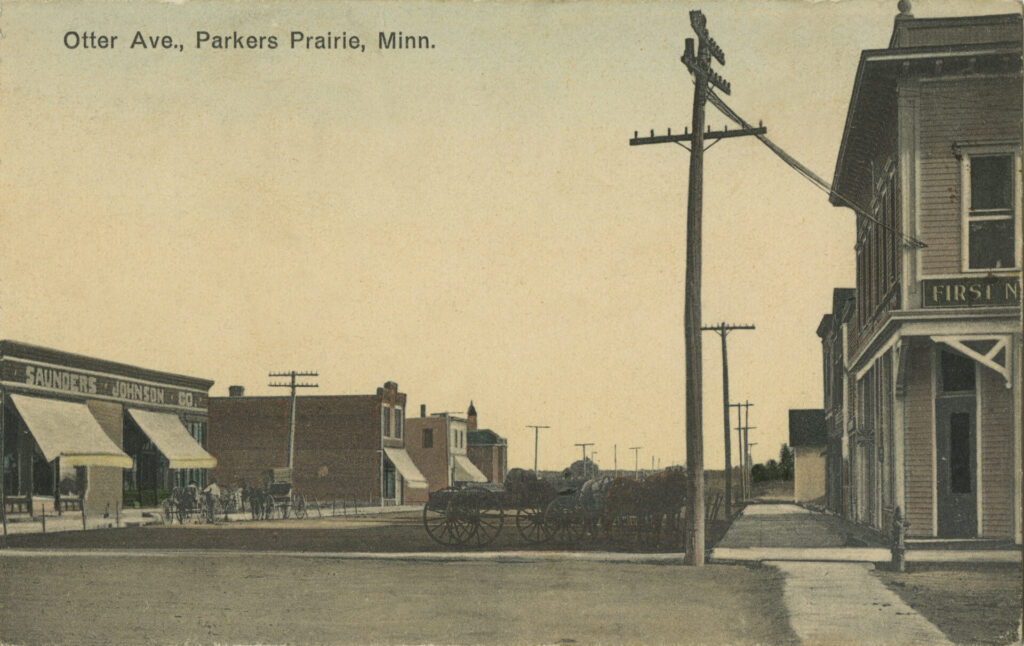
Parkers Prairie Commercial District
“By 1880 there were two general stores, two blacksmith shops, two hotels, a millinery shop, a one-room log schoolhouse, the First Baptist Church,
and a number of private homes.” By 1890, several grocery and dry goods stores had been added to the village, along with a drug store, harness shop, shoe store, furniture store, flour mill, and creamery. In 1919 St. John’s Lutheran Church was organized.
Steam Engine
In 1990, the Lions Club purchased the first steam engine to arrive in Parkers Prairie via the Soo Line railroad in 1903. It was refurbished and is now on display in the City Park.
Using wood or coal as fuel, the Parkers Prairie steam engine powered threshing machines used to harvest wheat. Before such machines were developed, threshing was done by hand with flails, a back breaking labor intensive process. Mechanization not only improved production, it removed much of the drudgery from farm labor.
![[From the collections of Otter Tail County
Historical Society]](https://eadn-wc02-557916.nxedge.io/cdn/wp-content/uploads/steam-engine-edited-1-1024x829.png)
![Elevators and Mill, Parkers Prairie, circa 1916 [dedicated by Otter Tail County Historical Society]](https://eadn-wc02-557916.nxedge.io/cdn/wp-content/uploads/9528dpi600-edited-1024x652.jpg)
Elevators & Mill
“Grain elevators were crucial for the efficient handling, storage, and transportation of grain, revolutionizing the agricultural industry by enabling
bulk storage and facilitating trade, especially with the rise of railroads.” Fun fact: the four grain elevators erected in 1903 were not built on site,
but were hauled in by a flat car from a distant “elevator factory.”
