Guide Lines: Approaching Ice Early in the Season
December 21, 2017
Recently, I heard on a Twin Cities channel, that the ice was unsafe and there was a DNR segment about why it’s not safe anywhere. Both portions of that news segment painted a scary picture of ice. Sometimes that’s okay, but it can be conflicting especially when there are folks out on the ice using lakes safely. What to do? I’ve been a full-time ice fishing guide service for 20 years and have lived and grown with ice. I have feared it and I have embraced it but most of all I respect it all season long. There are a couple of things to understand about ice and how to approach it.
Never take ice for granted—in a way, it’s never safe, you just have to be smart and be cautious. It’s like driving a car on slippery roads (something that we’ve all done). Most accidents on lakes in the winter occur around or near current areas. Check this out—stay away from current areas!! If you’re unfamiliar with a lake, get a map and find out where there’s current. On that note, never drive an ATV or vehicle around the shoreline of a lake—that’s where most cracking and heaving occurs and that’s where all current areas are, i.e. inlets and out lets!
Lets use our heads here. I enter ice situations optimistically but cautiously. I do a lot of walking on ice early in the winter. I know at this day and age, that that sounds odd, but a lot of people have forgotten they can walk—yes, walking is still an option. Just because you have an ATV doesn’t mean you have to use it. Or just because you see other ATV’s on the ice doesn’t mean you’ll take the same safe course the others did. And just because you don’t see any ATV’s on the ice doesn’t mean you can’t use one. You just have to go out on the lake, on foot, and find out if the ice is ready for you. It works both ways, ice is good and bad, but most of all, you need to figure out whether it’s right for you.
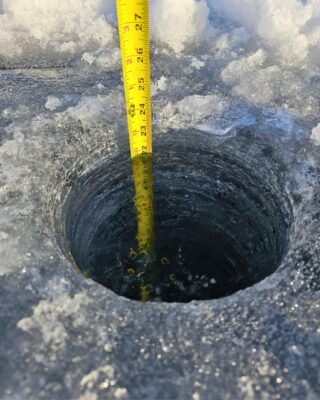
Finally, knowing how to weigh ice reports/stories is difficult—whether they are from big news channels 200 miles from your lake/ice destination or if they are local. Do some research and find out what’s going on. Call a fishing guide service in the area and active reputable resorts and see what they say. When folks call me, I’m usually vague because I want everybody to figure out what is safe for them—every one is different. I simply tell them whether or not I’m fishing/guiding or not, but will never tell a person it’s completely safe, because that very person might drive right into the river on the lake that same day. No matter the report—positive or negative— you still need to be smart and do your own physical research once you arrive at your lake or pond. Just yesterday some anglers asked me if the ice was safe—it’s a very difficult question to answer. I told the anglers that they should walk down onto the ice (with out their ATV) and drill some holes and determine if it was right for them.
We’re all exited to get out and fish, but every individual angler needs to research their own fishing space—it’s the careful thing to do and it’s the best thing to do. If your gut tells you it’s not ready. Head home and wait a few days. There’s a lot of winter ahead—it’ll happen.
Before I wrap up my essay about approaching ice, I wanted to give a couple of ice usage tips and cautions that are good to know about early in the ice season.
—Keep an eye out for cracks, especially if you’re hauling or pulling heavy fish house loads across lakes that only have 5-10 inches on them. Five and ten inches of ice can hold quite a lot of weight, but when the ice separates because of shrinkage or expansion it’s strength is well compromised and can snap off under loads. It’s the number one reason large fish houses fall into a lake this time of year. If you’re pulling a house and you see a crack in front of you, stop and make sure it’s passable.
—Snow is an amazing insulator. When lakes have about 8 inches of ice on them, cold does not easily penetrate the ice, which ultimately slows ice making. Not only does ice making slow when the ice gets thicker, but if there is any amount of snow on a lake or river surface, it undoubtably slows and sometimes halts ice-making. Even if temps are 20 below zero—a couple of inches of snow will insulate an ice and prevent ice making. Therefore, just because it’s bitterly cold outside for a few days, don’t assume the ice got thicker!
Good luck and be safe on the lakes!
By Ross Hagemeister | meisterguideservice.com