How should you approach new ice, first ice?
Fishing is at a very slow crawl in Otter Tail Lakes Country. Some lakes that had fishable ice 10 days ago were set back by snow fall and now that warm temps have settled in, what ice is still around should be considered unsafe. IF, you should come to Lakes Country to try and fish—watch your step. Since ice and safety seem to be the overlying topic this December, here are some tips on how enter ice fishing this season. How should you approach new ice, first ice?
Gear Checklist
1. A partner and or make sure someone knows where you’re going.
2. A handy length of rope and let in drag behind you when you’re walking out.
3. A chisel or “spud” bar—the heavier the better
4. Wear a life jacket
5. Ice gripping tool that helps you get a grip on the ice if you’re in the water
6. Cell phone
What to do
1. Always be skeptical. Never trust ice reports. One person’s idea of “safe” ice might be standing two steps onto a lake, and deeming the lake safe. The opposite is true too. The ice might be very safe but some folks call it unsafe. You need to take a look for yourself before you just walk (or drive) out on a lake.
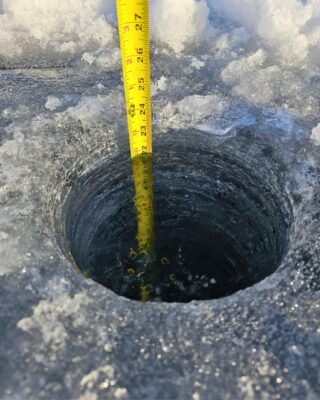
2. Take baby steps. Go slow and listen for cracking. If you get ten feet off shore and it feels good and sounds good, start prodding the ice with a chisel or hand auger once every step with chisel or drill a hole every few yards with the auger. You’re not just looking for “thick enough” ice, you’re looking for consistent ice.
3. You should also be surveying the quality of the ice. Good early ice is very clear and usually dark—because the lake is dark, especially over deep water. If the ice is cloudy or light, then exercise extreme caution. White ice is typically softer and not near as strong as dark ice. When ice is cloudy and soft it usually doesn’t crack and make noise the way hard ice does. It’s very difficult to tell when it’s going to break.
4. As far as I’m concerned, if you’re only interested in walking out, then you should want at least 4 inches to begin your walk. ALWAYS use the rule of 2. Take the number of inches of ice you find, and immediately subtract that number by 2. If there’s 4 inches of ice on the lake—on average—then there’s going to be 2 inches somewhere. If there’s 6 then there’s 4, etc.
5. If you’re only interested in driving out with your ATV for your first outing, then that’s too bad. You need to get off the machine and walk a course and learn how thick the ice is first, before driving on it. Don’t let lazy kill you. I like for there to be 7 inches for my side-by-side.
6. Finally, throwing a rock at the lake from shore is not a valid ice check. Cavemen used that method and we’ve been fresh out of cavemen for about 60,000 years.
By Ross Hagemeister, Meister Guide Service