
Otter Tail Lake
Fur Trade
Fur-bearing animals were plentiful when French fur trappers came to Otter Tail County in the early 1700’s.

Talking Trail Audio Story
Cashless Commerce
Native Americans were skillful hunters and trappers of bear, beaver, bobcat, lynx, buffalo, coyote, deer, fox, wolf, and many small mammals
such as muskrats, skunks and weasels. They would trade the pelts (skin & fur) of these animals with European Americans for items such as iron cooking kettles, knives, guns, spears, cloth, sugar, flour and liquor. This barter system became known as the fur trade.
A Wealth of Pelts
Felt hats were popular in Europe from the 1600s through the early 1800s. Felt was made of prime beaver pelts, many of which came from Minnesota.
Beaver pelts were a unit of exchange in the fur trade. The high demand of beaver pelts led to their rapid decline. As they became scarce, they were replaced with muskrat pelts. In 1835 sixty muskrat skins would buy a blanket or tin kettle; a gun was worth one hundred skins.
From the Weekly Journal, Jan. 4, 1883: “Morrill & Brandenburg yesterday shipped to St. Paul the furs taken in by them in the previous 17 days, as follows: 7000 rat skins, 200 mink, 25 wolves, 20 coons, 15 foxes, 7 skunks and 1 otter. There are half a dozen other parties buying furs in this city.”

Traders & Trappers
The French voyageurs were the backbone of the fur trade. There were two classes of voyageurs (a French word meaning traveler). The “pork-eaters” were beginners who took trade goods to the main exchange posts early each summer, and then took the furs back to Montreal. The “winterers” were more experienced men who, under the direction of the clerks and fur trade company partners, spent winters at interior posts, exchanging trade goods for the Native American’s furs. The voyageurs learned to use the birchbark canoes of the Chippewa Tribe. Canoes made of birchbark could carry about 3,000 pounds of goods. They were usually twenty-five feet long and were manned by crews of eight “winterers.”
The mainstay of the voyageurs’ diet was a thick soup made of dried peas or lyed corn, supplemented by berries, bird eggs, fish, game, wild rice, and dried pemmican (pounded buffalo meat and berries preserved in grease), which sustained them as they paddled twelve hours a day and walked the portages carrying heavy 90 lb. packs.
The Northwest Fur Company, a branch of John Jacob Astor’s enterprises, established a post at the east end of Otter Tail Lake in 1797. The British Fur Trading Co. was established in 1806 on the Leaf River to the east of Otter Tail Lake, and the Columbia Fur Company came to Leaf Lake in 1862.
![First Store, Hudson Bay Post on Otter Tail River, Hobart Township, Otter Tail
County, Between Luce and Frazee, Minnesota [#2041 from the collections of
the Otter Tail County Historical Society]](https://eadn-wc02-557916.nxedge.io/cdn/wp-content/uploads/2041dpi600-1024x829.jpg)
The Lake Route
Otter Tail Lake, Leaf Lake and the Otter Tail River played an important part in the route of the fur traders. These waters formed the link between the Red River which flowed northward into Canada, where the Hudson’s Bay trading posts and the Selkirk Settlement were located, and to the south, the Mississippi River chain. There were rapids, at the present location of Fergus Falls among others, but the only long portage was from Otter Tail Lake to the Leaf Lakes. Following the Leaf River east leads one through the Crow Wing River to the Mississippi, then on to Ft. Snelling. The Leaf Lakes were about at the center of the whole river transportation system — the highway of the days when the swiftest travel was by canoe.
Too much trapping, new fashions, the Civil War and the Indian Uprising of 1862 hurt the fur trade. After the War, the importance of this area’s agriculture grew. Fur trade’s best days had passed by the mid 1800s.
Otter Tail Lake
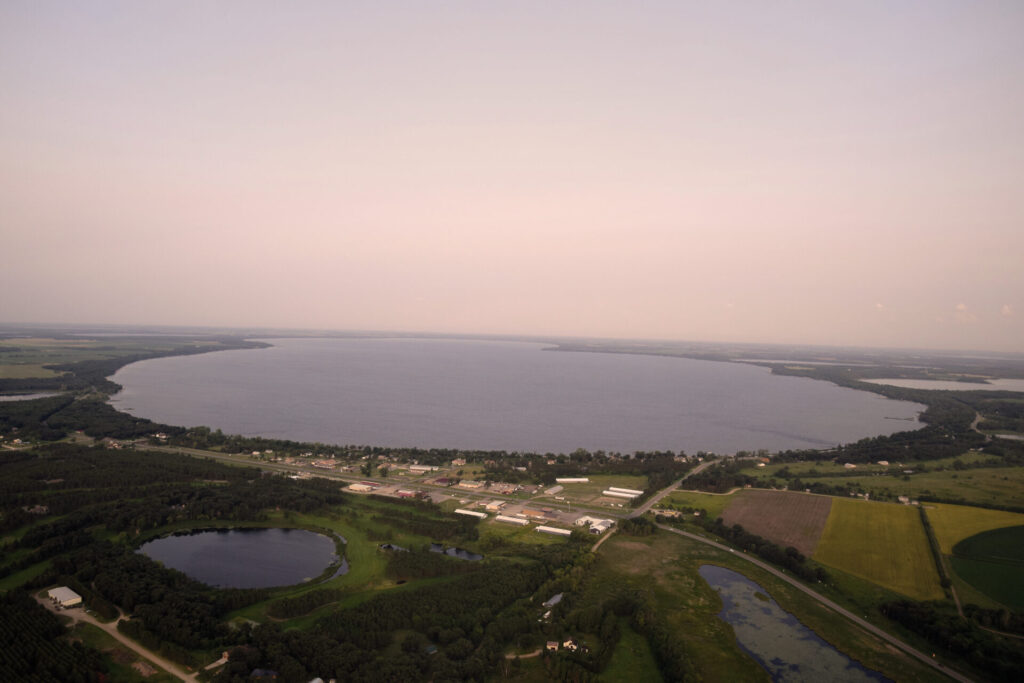
In 1750 the first explores in the area met with a band of natives on the shore of “Lac de la Queue de la Outer” which translates roughly to the “Lake of the Otter’s Tail.” The name derives from the sand bar shaped like an otter’s tail where the Otter Tail River enters Otter Tail Lake (on the North East end of the lake) and now over two centuries later the otter’s tail sand bar is still there.
This area of Minnesota is known for its natural diversity of waterways with numerous lakes, ponds, sloughs and rivers. Otter Tail Lake is 21-square miles (13,728 surface acres) and is the largest lake in Otter Tail County. It is a premiere fishery for walleye and offers a variety of angling opportunities for crappie, sunfish, northern pike and bass. Sturgeon, a unique, prehistoric species, have also been stocked in Otter Tail Lake and can be caught and released beginning in June.
